
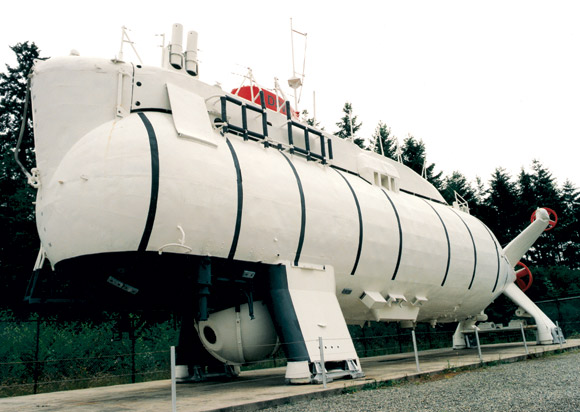
Trieste II (DSV 1) on long-term display at the museum
Current status: On exhibit
Location: Outdoors
Trieste II (DSV 1) was a Navy deep submarine vehicle that performed undersea research and tasks, including examining the remains of USS Scorpion (SSN 589) in 1969 and carrying out a now-declassified secret recovery operation in 1971–1972.
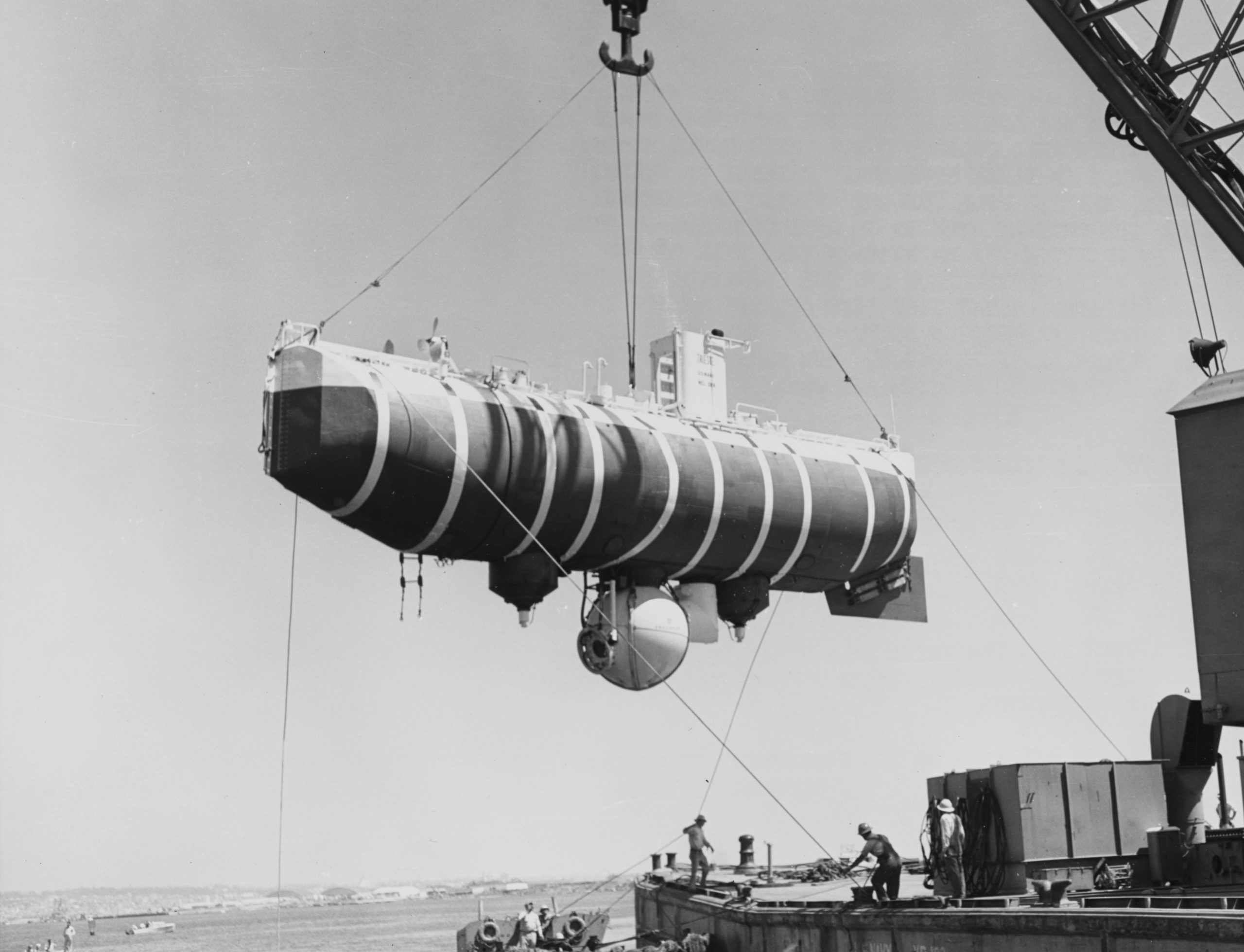
Bathyscaphe Trieste circa September 1959
The first Trieste (right) was designed and built by Swiss physicist and inventor August Piccard in 1952. In 1958, the U.S. Office of Naval Research purchased Trieste and assigned it to the Naval Electronics Laboratory, San Diego. The most significant of the many scientific programs Trieste participated in was Project Nekton, which sent it on a 35,800-foot descent into deepest part of the world’s oceans, the Challenger Deep. For this series of dives, Trieste’s original 20,000-foot Sociète Terni-built sphere was replaced by one manufactured by the Krupp Works of Germany designed for operation to 36,000 feet. In 1963, Trieste took part in the search for the sunken submarine USS Thresher (SSN 593).
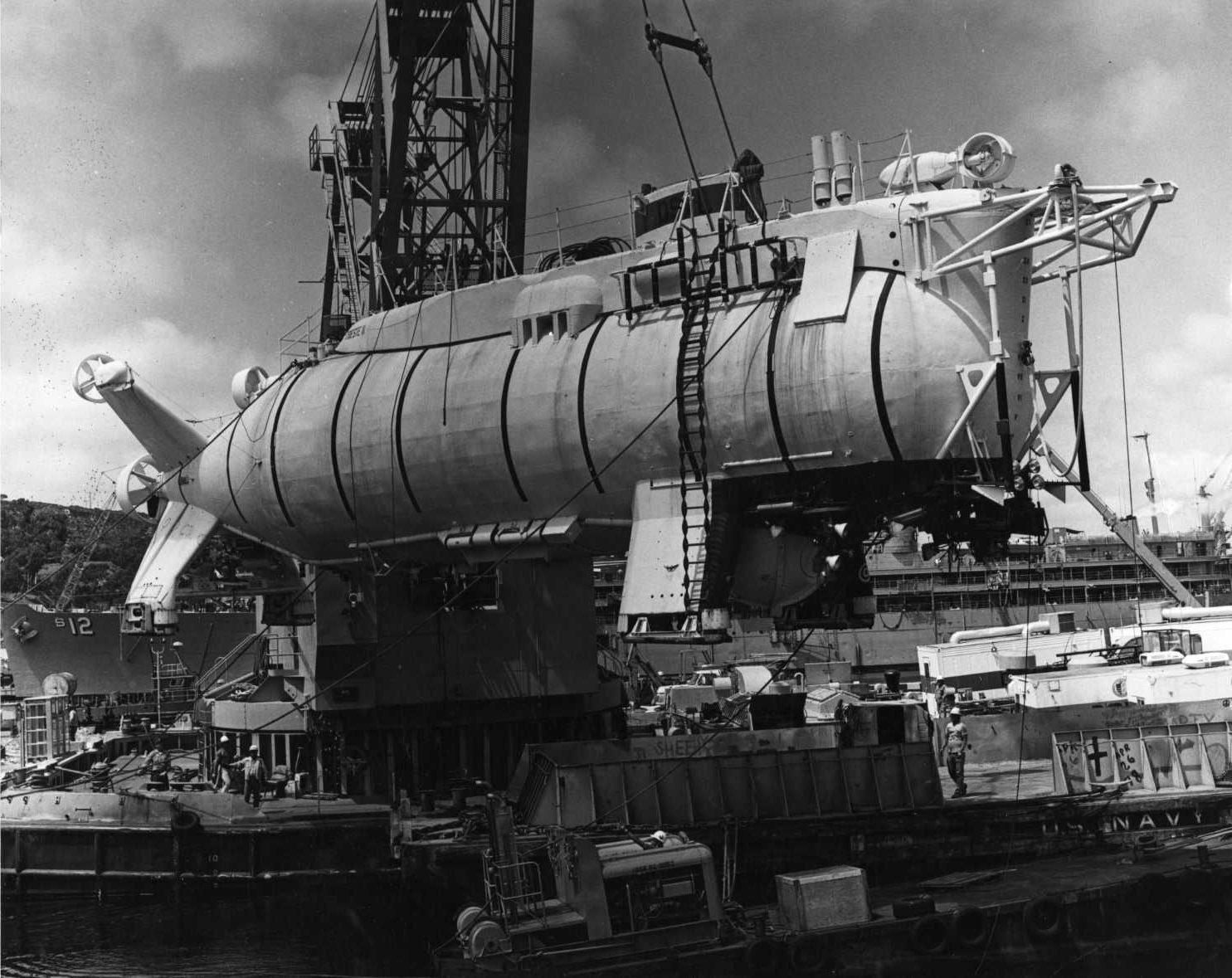
Trieste II (DSV 1)
In the fall of 1968, Trieste II (DSV 1) was certified for an operating depth of 12,000 feet; a year later, it investigated the Scorpion wreckage, completing nine dives over 10,000 feet deep to survey and photograph the remaining debris. Its Integral Operating Unit, consisting of Trieste II, White Sands, and support ship tug USS Apache (ATF 67) received a Navy Unit Commendation for this effort. In 1972, following an overhaul, Trieste II (DSV 1) was certified to 16,500 feet. For being the first submersible to retrieve objects from a depth of 16,400 feet during a secret mission declassified in 2011, Trieste II received a Meritorious Unit Commendation in 1972.
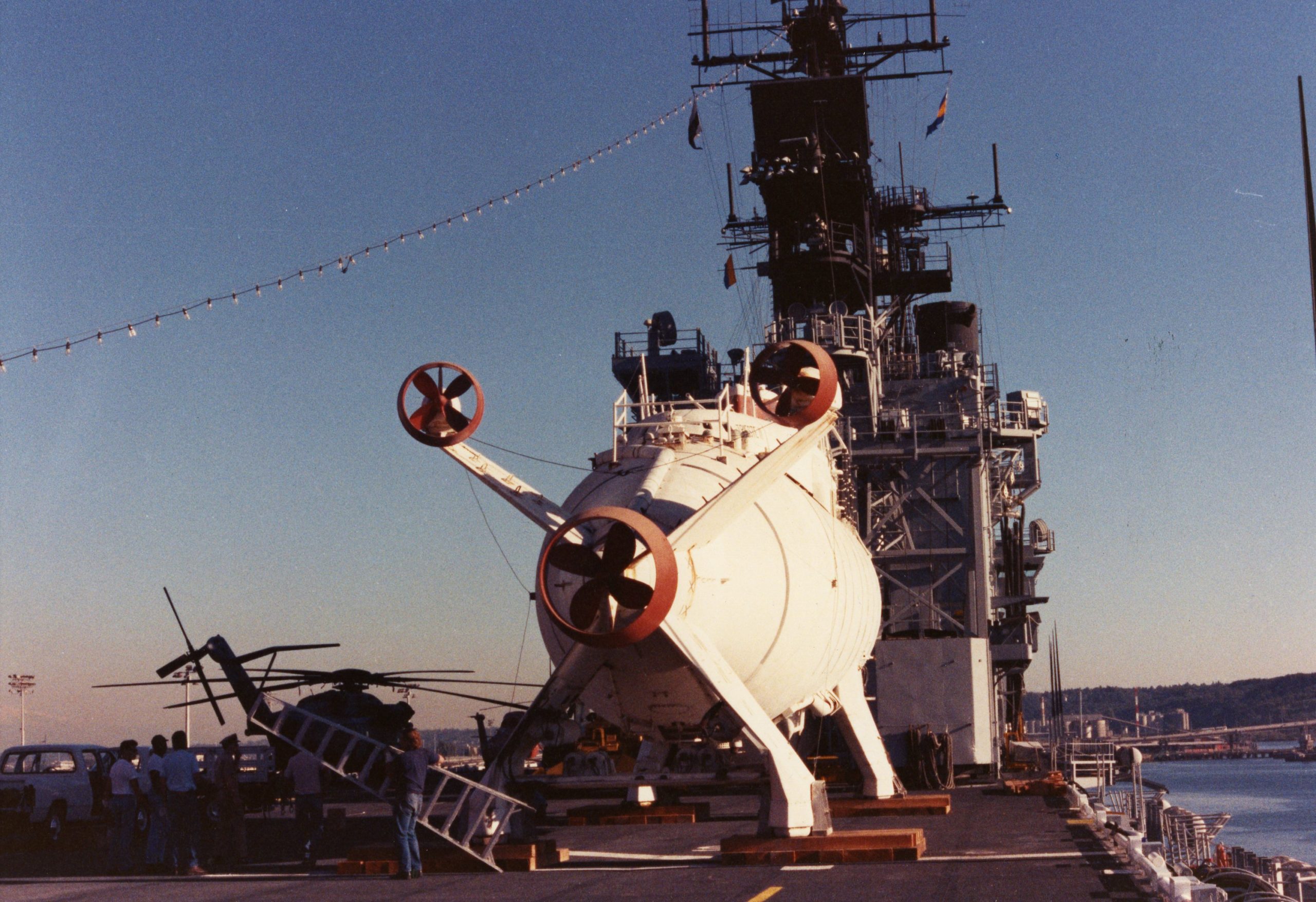
Trieste II (DSV 1) en route to the museum via a lift of opportunity from USS Belleau Wood
White Sands and Apache were decommissioned in 1974; a dock landing ship was renamed USS Point Loma (AGDS 2) and converted into Trieste II’s new support ship. Point Loma’s modifications were complete in early 1977, and during training dives with Trieste II, the submersible was certified to 17,250 feet. Later that same year, its operating depth was increased to 20,000 feet. Trieste II remained in active service in the Pacific Fleet through the early 1980s. It was given permanent leave from the Navy in 1984, earmarked for the U.S. Naval Undersea Museum in 1985, and moved to the museum in August 1988 for long-term display.